
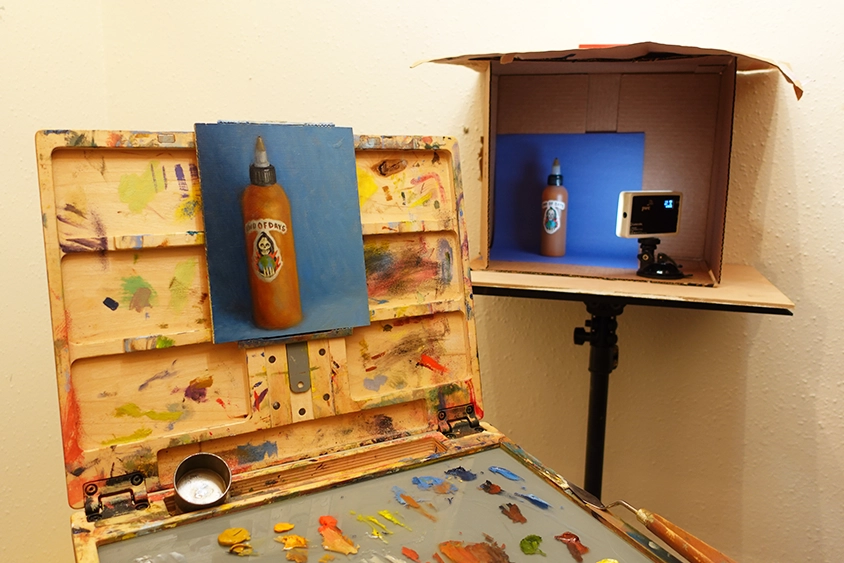
Is painting from life harder than painting from a photographic reference?
Many people will say yes, I am here as a contrarian to say…
Not necessarily, it depends.
You may be surprised to learn that painting from life can be easier and more fun, all while yielding a more interesting painting.
Today, I will attempt to make that case.
Painting Tips, Tricks, Tools, and Hacks
I’m no stranger, nor am I opposed to using all the great painting tricks and tools that modern technology affords us. Employing the use of grids, projectors, doodle grids, and transparent overlays in Photoshop all have their utility when it comes to painting murals and easel paintings.
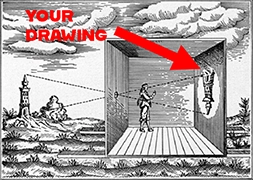
I was surprised to learn that even the old masters employed technology to actualize their masterpieces centuries ago. Devices such as the camera obscura (pictured above) and other types of cutting-edge lens technologies were used to assist artists put their initial sketches down quickly and proportionally.
We’re not here to debate the legitimacy of using such devices to assist in the painting process (at least not today). But i did want give these methodologies their moment before diving into the truly age-old technique of painting from observation, also known as painting from life.
Photographic Reference
Our entire modern existence, in large part, is mediated by the camera. We all have these devices in our pockets, we just call them phones – but really, they’re cameras that are able to make and receive calls. We should call them cameras and if you’re like me, you probably shoot more photos than you take calls anyway.
That said it’s easier than ever to snap great photos all day long. And it can be very tempting (albeit quite lazy) to think that a great photo will yield a great painting. I’m not making the case that it can’t or that it won’t, just beware.
This is just one brief consideration when working from a photograph versus working from life: You may end up with an epic cache of paintings that ultimately read as photos rendered in paint.
The case for Painting from a Photograph –
-because, of course, there is a very strong case to be made. We are so lucky to have this technology, when I look at portraits from way back when, I sometimes think – “How did they do that (without using a photo)?” A painting that always makes me think of that is The Tiger Hunt by Peter Paul Rubens which I briefly discuss in this Episode 4 of Painting of the Week.
Here’s an example where working from a photo is essential: you’re painting a portrait and you don’t have someone willing to sit for you over the course of 10+ sessions, totaling 50 hours.
Lucien Freud, the great contemporary English figurative painter (grandson of Sigmund Freud), famously painted all his figures from life, often having them pose for him over the course of many, many sittings. No doubt his strict adherence to painting from life allowed his paintings to achieve a certain quality, but we’re not Lucien…
So we work from photographs, and nevertheless, we are still able to achieve great results.
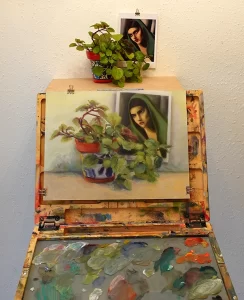
The Unlikely Problems of Painting from Photographs Creates
When working from a photo, the benefits are numerous. Here are four I can think of:
- The subject (person, landscape) is unaltered, the person doesn’t move, the sun doesn’t change
- You are able to summon this reference image at your convenience – for example, painting a photo of a bright sunny landscape in the middle of the night in your studio
- You can splice and compose many photos into one composition, haters will call this photobashing (it can work, it can also not work, you better be a good composer)
- You have endless detail and information to reference for your painting, for example, you can 10x zoom in on your landscape and render each blade of grass (boring!)
It’s this last point that can be both your greatest weapon or the largest hindrance to having fun and making a great painting.
If you’re painting a portrait for a client…
..chances are they want some photorealistic thing with minimal artistic interpretation. Really, they want you to download their photo in oil paint, which is cool; that’s a very real hustle, and in this case, having a photo to work from is crucial for success.
Pro Tip: Make sure the photo is flattering to the sitter(s) and every element of the photo makes sense, because if it doesn’t, then neither will your painting!
Enter: Painting From Life
We’ve established there is a time for rendering immense loads of detail, like when you’re contracted to be a paint download machine.
There is also a time to not get overloaded with detail and paint from a more intuitive place, painting the impression of the object and not the symphony of pixels that compose the photo.
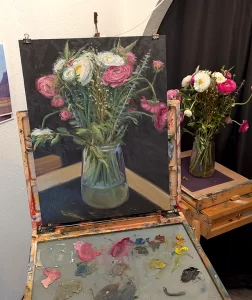
The bouquet of flowers or the crystal skull photographed here are great examples. Painting either of these from a photograph would have the potential to devolve into a lost-in-the-sauce-slog of a paint, which wouldn’t be very fun (because that matters too, right?)
However, when I paint these subjects from life, I am unable to get too lost in the weeds. This means that I need to use my brain and my creative faculties to find functional, convenient, and interesting solutions to the problems of needing to suggest lots of information, whilst not spending 100 hours rendering it.
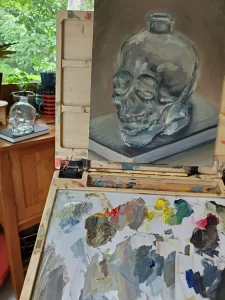
Painting The Crystal Skull
In the case of the crystal skull, the number of planes of light dancing across the surface of this object would literally be insane to paint. Of course, I could work from a photo and still try to maintain an impressionistic touch; however, I am way more likely to get stuck in the mud 2x-ing, 10x-ing, and 50x-ing the zoom on certain spots while proceeding to pick up smaller and smaller brushes. Before I know it, I’m on my third sitting of this 8×10 inch panel, and maybe I have even achieved a photographic effect, but who cares. That doesn’t mean it’s an interesting painting, or even a good painting.
Flexing technique doesn’t make you an artist; it makes you a paint technician.
It’s About Having Fun
If painting from a photo is fun, then who am I to say otherwise? Painting is meant to be enjoyable, otherwise why do it?
I only want to dispel the conception that painting from life is inordinately challenging. And while it can be a challenge it also forces you to adapt as an artist, making you a stronger painter when it is time to retreat to the studio and be the oil paint download machine that clients pay you to be.
If you have never painted from life, I encourage you to give it a shot.
You may be surprised at what you see when you start looking.