
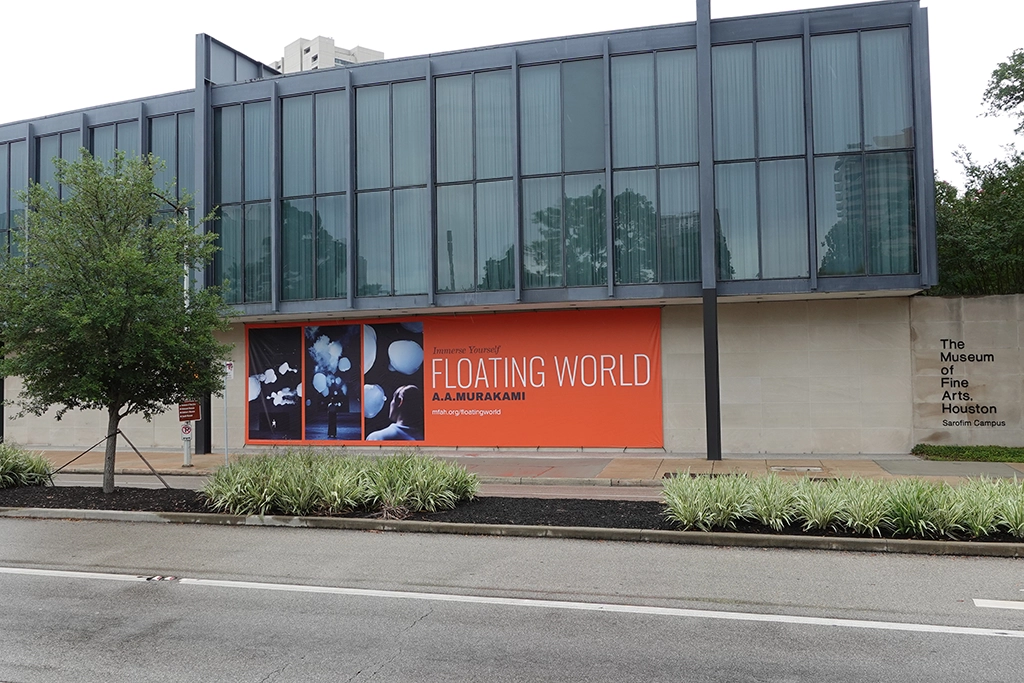
Coming up for air from AA. Murakami’s Floating World show at the MFAH leaves me with a fleeting sense that perhaps I would be better off as a cave dweller than a terrestrial-bound Houstonian.
The states of primordial ease cultivated by the four highly curated environments are ephemeral in design, inviting us, as experiencers, to absorb each precious moment of the show, knowing they will never be repeated.
Are you in?
Wielding ephemeral tech, the creative duo, Alexander Groves and Azusa Murakami, reimagine the floating worlds of Ukiyo-e for a 21st-century audience. Ukiyo-e prints, or “pictures of a floating world,” were popularized in Japan’s 17th-19th centuries as a means of pictorial escapism for a growing merchant class. Historically, to visit the floating world is to leave all your earthly concerns behind, temporarily, in exchange for pursuits of desire and repose.
An ambitious bar to set, no doubt, for a contemporary art-going audience with singed retinas and chihuahua-sized attention spans (present company included).

Upon entering the show..
Your eyes descend on two large moonrocks presented as sculpture. Despite their out-of-this-world porous sheen, the exhibit encourages us to meditate on these synthetic objects as representations of Earth in the Zen garden of life. The consensual game of technology disguised as nature and attendance masquerading as attention begins.
On the other side of the asteroid belt hang two suns, Neon Sun and Beyond the Horizon, two illuminated squares composed of alternating bands of colored light. Within each square sits the circle that our collective existence is forever indebted to. As with the asteroids, these art objects are not what they seem. AA. Murakami has employed neither neon nor electricity to bring these shuttered gradients to their muted brilliance. The effect of these pieces is achieved by plasma (the fourth state of matter we are told) contained within an electromagnetic field, making one wonder what Robert Irwin might have achieved had he gotten his hands on plasma in the 70’s.
More than one aspect of this show makes me think of the late, , but we’ll revisit him at the end. It’s time to plunge into the…
Floating World.
Walk through the black curtain, and you’re underwater, the depth of which is up to you as the experiencer to decide. Bloated jellyfish with glittering contours undulate weightlessly across the void as you enter the space.
Did you see that one? And there goes another –
Each one more captivating than the last, as the artistic duo reminds us how to see.
But wait, those aren’t jellyfish at all. Those are soap bubbles filled with dense fog. You are reminded of the magic of bubbles from childhood, and how they collapse into nonexistence, leaving behind nothing but a sticky residue that slowly coats the ocean floor.
These moments are here for the experiencing.
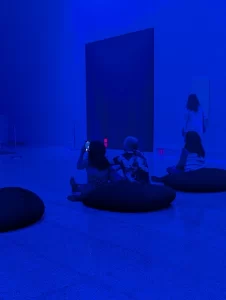
If you are savvy enough to find the entrance to the next room, welcome, a powerfully dim blue light greets you. The bumbling jellyfish have now calcified into beanbag chairs, inviting our bodies to emulate their weightlessness. Lay back and enjoy Passage, where circular rings of fog are launched towards you only to disperse before making contact.
Am I in the green room after a rap show? Or have I burrowed deeper down into the depths where geothermal geysers expel hot air? Whatever the case may be, each gust of fog, according to the artists, is:
“random, uncontrollable and unpredictable — a parallel to our own lives in our ever expanding universe.”
Wait, is it all just ephemeral?
By the fourth and final room, you, alongside other travelers, have penetrated so deep that you now occupy the center of the earth. This cavernous red room buzzes with an ordered chaos that sets the mind at ease. A seemingly infinite number of plasma-filled tubes hang perfectly at 45-degree angles from the low, imposing ceiling. The collective buzz of the tubes punctuated by a profound stillness, followed by a buzz here and a buzz there (everywhere a buzz buzz), makes one feel as if they’ve peeked behind the Creator’s curtain to discover that there is a method to the madness.
Hold that thought. Hold that feeling.
Because once thrust back into the MFAH, it’s over. Welcome back to the surface earthlings, where the only guarantees in life are death and taxes. Now you see why I am left with a primordial nostalgia for the ooze from which I came.
I took the ride that AA. Murakami constructed, and I was rewarded with brief states of psychological repose and existential reflection. I did my part, I upheld my end of the bargain.
Had I not, I may have instead left the show with a collection of photos to document the journey. Photos signaling that I came, I saw, but did I experience? The anti-ephemeral journey, the impulse to cheapen every special moment with a photo.
I’m left wondering how much more potent the descent into the Floating World could have been had the public not been permitted to contradict Murakami’s ephemeral tech with their own anti-ephemeral tech. Robert Irwin famously did not let anyone photograph his work for decades, citing that photography could not sufficiently convey the experience of his art.
Why permit the production of false substitutes, Irwin claimed. Why indeed. But that was then, and this is now, and there is no sense in investing too much energy in idealizing the past because if Floating World by AA. Murakami teaches us anything it’s that this moment, too, is ephemeral.