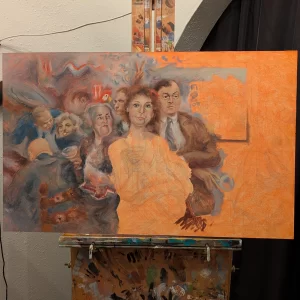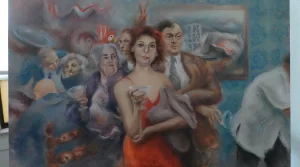
I finally started the Rosemary Mahoney project that the gallery tasked me with almost one full year ago. I was told no rush so I took my time and I’m glad I did. I don’t know if I would have had the skill or confidence to execute the painting the way I feel equipped to do now.
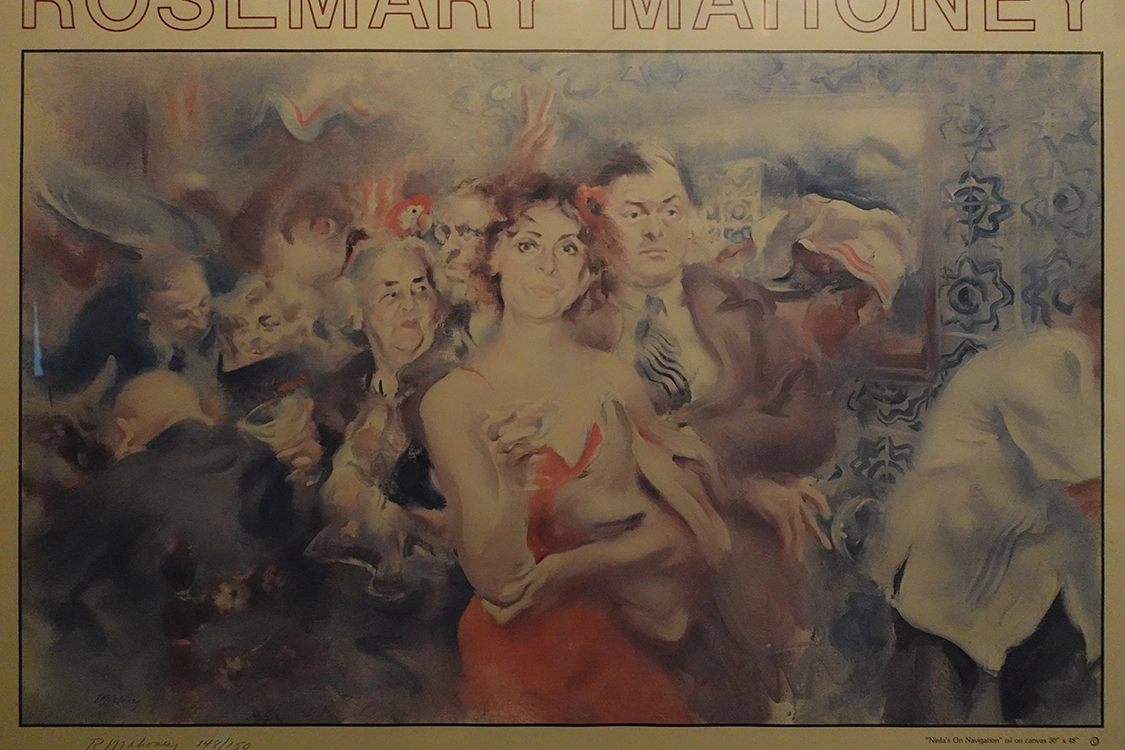
The main problem is that the painting is immensely spontaneous – abstract, and much of the painting is composed with extremely thin passages of oil paint. In fact it seems like this is how she painted in general, extremely self-assured, confident and with thin oil paint. Paint with lots of turpentine in it. Her paintings (I’ve never seen any before) probably have very little impasto or texture to them.
I am working from a print of a 30 x 48 in a painting that she made many years ago. I have had the framed print hanging in my studio for a long time and it was only today that I took it down to photograph it and begin doing all the preproduction schlep necessary to essentially execute a master copy of this Rosemary Mahoney painting. It’s a bit strange but I feel close to her while I study the painting as I make my drawing on my gridded panel. I was recently listening to a Wayne Thiebaud lecture about the importance of doing master copies and how it gives you a chance to make a real connection with the artist (get in their head) and I very much already feel that effect with this Mahoney painting. It’s really quite special.
Six or 12 months ago this painting might have been a nightmare for me to copy (or rather interpret) because so much of it is spontaneous and low resolution, i.e. not a lot of visual certainties for me to grab a hold of. But I am at a point where I trust myself. Maybe I will even make a very strong painting after Mahoney in my own right. I will bring the portraits, there are maybe 5, to a certain degree of resolve and then loosen up as I expand out accordingly so that essentially the contours of the painting are completely abstracted.
I see how she composed this picture. It is very solid, it is in the form of a triangle, with a very sturdy base all building up to the central figure’s portrait. It is Ninfa, as in the popular restaurant chain here in Houston, Ninfas. I have been to the one on Navigation a few times, it was actually one of the first places to eat Magdalene took me to when I came here to Houston.
So this project has begun, the timing is good. Something tells me once I get entangled into this painting I won’t be able to do anything but resolve it. What I’m saying is I don’t anticipate this painting will drag a lot of ass the way certain recent commissions have this year. I could already feel myself getting quite swept up in it just putting the initial drawing down earlier. Tomorrow I will resolve the drawing to a further extent then immediately start loosening up. With a pen I will block in all the light and shadow patterns before I layer transparent passes of gesso down (cheap gesso = transparent) and then I will immediately start putting down some very thin washes of acrylic. All before I start blocking in with oil. Success here will be keeping a freshness that she had, and even though it won’t be as truly fresh as the original artist’s freshness I trust I will be able to fudge it enough to make the picture work.
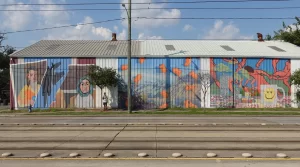
So that’s that. There are so many other projects to sink my teeth into right now including an 80’s night live mural painting event I will do this Friday, as well as a person mural project I need to do and then the WAG art Jones award submission I still very much plan to do (although I haven’t found the visual component to compliment my rather robust conceptual layer of my proposal) and then lastly really sinking my teeth into the feasibility of a MA in Art History which much be prepared and applied for in the next 3 – 4 months.
Quick note on that: I got a decent dose of reality today when I learned that the VCU MA Art History program only accepts about six applicants A YEAR. So there’s that…
I will need to write a Hail Mary paper to make this happen, at least that’s my current feeling, although the extent to which that is grounded in reality is big time TBD as well. I guess that’s why I characterize that move as a Hail Mary, because technically it could happen.
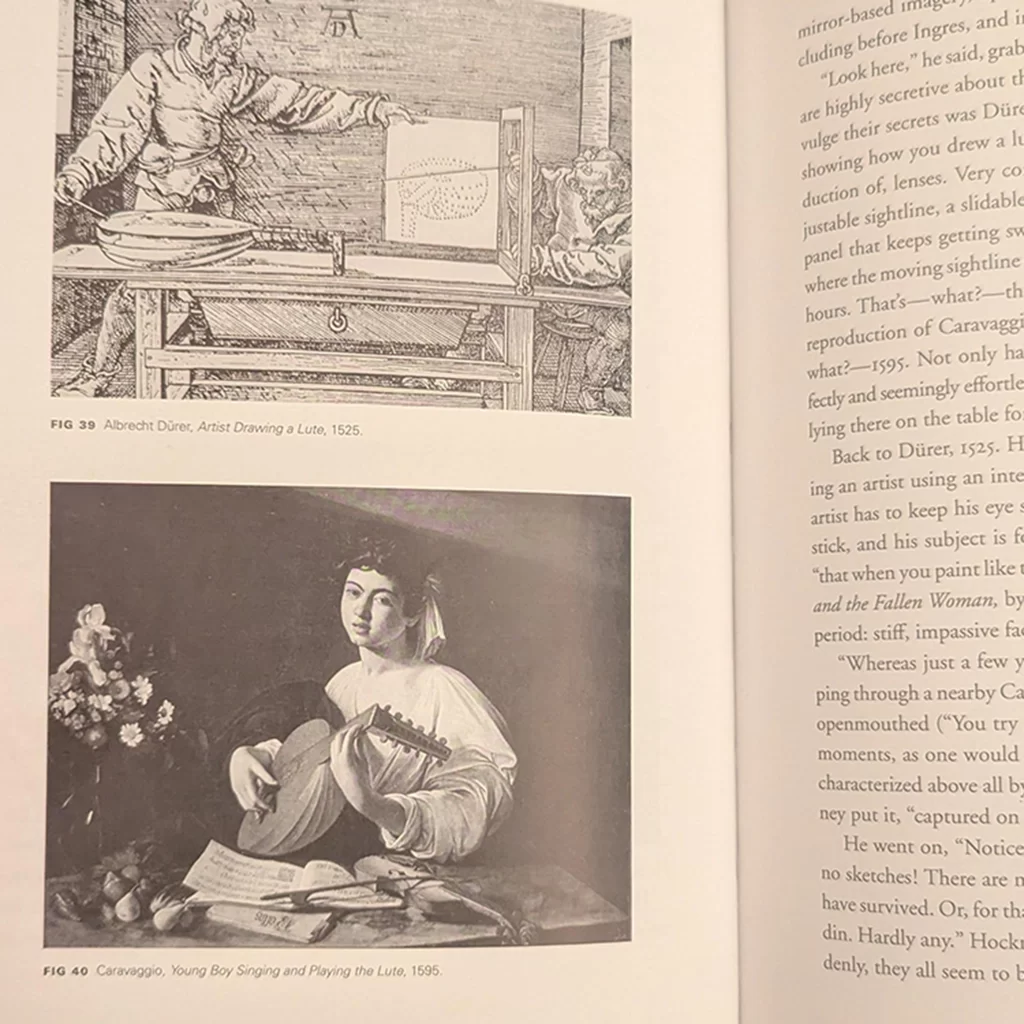
In keeping with the above theme I was just rereading a section from Lawrence Weschler’s book on David Hockney and in the middle of the book – the book spans about 30+ years in conversation with Hockney- he spends some time with David while he is in the throes of being a controversial art historian unearthing the likely fact that many of the great masters used optical devices. It was 1999 that Hockney was pursuing this hypothesis. I am extremely curious as to how mainstream this has now become in the last 25 years or is this still a testy little bit of art history snooping?
I bring this up because this topic feels potentially ripe for me to expand out on my application paper. The problem is I am in such a vacuum, both in the world of painting but even more so in the world of art history inquiry, that I don’t know to what extent a thesis of this caliber is even “worthy”. I will certainly be throwing way more than one Hail Mary to make this new undertaking happen, because I will be reaching out to all sorts of people asking for help and referrals in order to write this paper but also get academic and art world references for this application.
Hockney’s thesis is essentially that starting in maybe the late 1500’s, right around the time Caravaggio was active, lens technologies were beginning to be employed in the practice of painting. For hundreds of years prior the quality of drawing and likenesses was “Awkward” and clumsy as David puts it. It’s quite plain and easy to see. And then beginning in Northern Europe with the Dutch painters (whom I know zero about, I’m assuming there is an Eyck here and an Arnolfini wedding here too) and then the Northern Italian painters you begin to have this amazing quality in their pictures (especially the portraits) that had not been seen prior.
The paintings leave tons of clues, lots of awkward distortions that indicate the use of lenses – in technical ways I cannot speak on – but places where the foreshortened hand in the foreground is smaller than the hand way back in the background, this was frequent in some Caravaggio’s.
Anyway Hockney presents an entire thesis that spans almost 500 years of western painting that I do find extremely fascinating. I spent a lot of time reading art history and art theory anyway but now I’m doing so on a mission to find a compelling thesis to write a graduate level paper on that will serve as my entry point on what will be an overall very midgrade graduate application.